
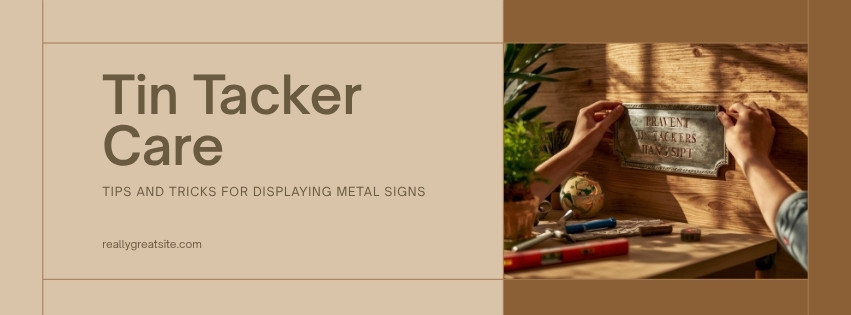
You've got a beautiful embossed aluminum tin tacker sign. Now what? Hanging and maintaining tin tackers is straightforward, but a few tips can make the difference between a sign that looks great for years and one that ends up crooked in a corner. Here's everything you need to know.
Hanging Methods
Most tin tackers come with pre-drilled mounting holes at the corners. The simplest installation is two small nails or screws — that's literally how they got the name "tacker." But you've got options depending on your situation:
- Nails or screws: The classic. Use small finishing nails or #6 screws. Pre-drill into the wall if you're going into drywall to avoid cracking. For brick or concrete walls, use masonry anchors.
- Command strips: Great for renters or anywhere you can't put holes in the wall. Use the heavy-duty variety — a standard 18" tin tacker weighs about 8-12 ounces, so even medium-duty strips will hold. Use two strips for stability.
- Magnetic mounts: Since tin tackers are aluminum (which isn't magnetic on its own), you'll need to add small magnetic mounting strips to the back. Stick rare-earth magnet strips to the back of the sign, then mount a steel plate or magnetic bar on the wall. This lets you swap signs easily — great for seasonal rotations.
- Wire hanging: For a more polished look, attach picture wire to the mounting holes and hang from a single nail. This gives a slight tilt forward that can look really nice for gallery-style displays.
- Standoffs: For a premium look, especially in retail or office settings, use small metal standoffs that mount the sign off the wall by about half an inch. It creates a floating effect and adds a shadow that looks professional.
Indoor vs. Outdoor Display
Tin tackers are primarily designed for indoor use. That said, they can handle covered outdoor spaces like patios, porches, and beer gardens with some caveats:
- Indoor: No special considerations. Hang it and enjoy it. Aluminum doesn't rust, and the printing is durable enough for decades of indoor display.
- Covered outdoor: Fine for areas protected from direct rain and prolonged sun exposure. Under an awning, on a covered patio, or in a beer garden with a roof — all good.
- Fully exposed outdoor: Not recommended for long-term display. Extended UV exposure will eventually fade the printing, and while aluminum doesn't rust, the mounting holes can collect water and cause staining on the wall behind the sign. If you must hang one outside, consider applying a UV-resistant clear coat spray first.
Cleaning and Maintenance
Tin tackers are low maintenance, but they do collect dust and grime over time, especially in a bar environment where they're exposed to cooking grease and smoke. Here's how to keep them looking fresh:
- Regular dusting: A soft cloth or microfiber duster is all you need for routine cleaning. Dust them when you dust everything else.
- Deep cleaning: For built-up grime, use a damp cloth with mild soap (dish soap works fine). Wipe gently — don't scrub hard, especially on the printed areas. Dry with a soft cloth.
- Avoid: Abrasive cleaners, steel wool, or anything with harsh chemicals. They can scratch the printing or strip the ink. No pressure washers either (that should go without saying, but you'd be surprised).
Arranging Multiple Signs
If you're building a wall display with multiple tin tackers, a little planning goes a long way:
- Lay them out on the floor first before putting any nails in the wall. Arrange them until you're happy with the composition.
- Mix shapes and sizes for visual interest. A wall of identical squares is fine but a mix of squares, circles, and bottle caps is way more interesting.
- Keep spacing consistent. About 2-3 inches between signs looks clean. Too close and it's cluttered; too far apart and they don't read as a collection.
- Use a level. Crooked signs bug people more than you'd think. Take the extra 30 seconds to level each one.
A well-displayed collection of tin tackers turns any wall into a conversation piece. Take a little care with the installation and they'll look great for years.